

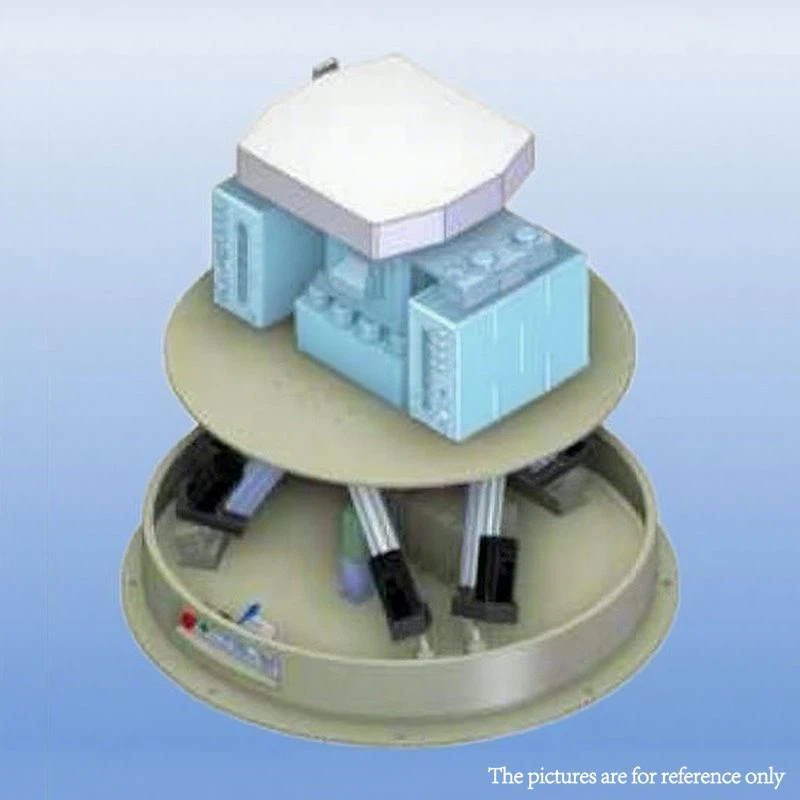
Longer Range. Smarter Detection.
Comprehensive Airspace Awareness.
The Medium-Range Drone Detection Radar is a high-performance airspace monitoring solution designed to detect, track, and classify low-altitude aerial objects at ranges of up to 8 kilometers.
Powered by advanced AI algorithms, active electronically scanned array (AESA) technology, and real-time edge processing, the system delivers reliable detection performance for airports, critical infrastructure, energy facilities, ports, smart cities, and industrial sites.
With 360° coverage, multi-target tracking capability, and seamless integration with electro-optical and thermal imaging systems, the radar provides continuous situational awareness and intelligent early-warning capabilities for modern airspace monitoring applications.
Key Features
8 km Detection Capability
The radar can detect targets with an RCS of 0.01 m² at distances exceeding 8 kilometers.
Benefits include:
Extended monitoring coverage
Earlier threat awareness
Reduced blind zones
Enhanced operational visibility
Advanced AESA Radar Architecture
The system utilizes four-panel Active Electronically Scanned Array (AESA) technology.
Features include:
Simultaneous transmit and receive
Multi-beam operation
High target update rate
Fast electronic scanning
Superior tracking stability
Compared with conventional mechanical radar systems, AESA technology provides faster response times and greater reliability.
AI-Powered Target Classification
The integrated AI engine can accurately classify:
Commercial drones
Consumer UAVs
Birds
Balloons
Helicopters
Other low-altitude flying objects
Classification accuracy exceeds 98.5% under operational conditions.
Automatic Optical Guidance
The radar can automatically guide:
Electro-optical cameras
Thermal imaging systems
AI visual verification modules
This enables rapid target confirmation and significantly reduces false alarms.
Fusion Platform Integration
The radar can be connected to centralized monitoring platforms for:
Multi-radar networking
Unified monitoring
Target correlation
Situation visualization
Event management
Technical Specifications
| Parameter | Specification |
|---|---|
| Operating Frequency | X-Band (9.5 GHz) |
| Detection Range | ≥ 8 km (RCS 0.01 m²) |
| Coverage | 360° Full Coverage / 90° Sector |
| Azimuth Accuracy | ≤ 0.3° |
| Elevation Accuracy | ≤ 0.5° |
| Peak Power | 200 W |
| Weight | ≤ 50 kg |
| Tracking Rate | ≥ 10 Hz |
| Simultaneous Tracking | 32 Target Groups |
| Anti-Interference | Adaptive Frequency Agility + Low Probability Interference Waveforms |
AI Radar Intelligence
Proprietary AI Radar Chipset
The radar incorporates a proprietary AI processing architecture capable of real-time edge analytics.
Capabilities include:
Inference latency below 5 ms
Power consumption below 3 W
Remote model updates
Continuous algorithm optimization
Online software upgrades
Micro-Doppler Recognition Engine
By analyzing target motion signatures, the radar can accurately distinguish:
Drones
Birds
Balloons
Rotary-wing aircraft
Slow-moving aerial targets
This significantly improves target identification accuracy and operational efficiency.
Intelligent AI Algorithms
Radar-to-Optical Verification
The system follows a multi-layer verification workflow:
Radar Detection → Optical Tracking → AI Visual Confirmation
This reduces nuisance alerts and improves confidence in target classification.
Adaptive Resource Scheduling
Using reinforcement learning techniques, the radar dynamically optimizes:
Beam allocation
Waveform selection
Processing resources
Tracking priorities
This ensures optimal performance in congested or complex electromagnetic environments.
Deep Learning Clutter Suppression
Advanced AI models suppress environmental clutter and improve target visibility.
Benefits include:
SNR improvement of 6–10 dB
Enhanced low-altitude detection
Better small-object tracking
Improved performance in urban environments
Built for Continuous Operation
Industrial-Grade Reliability
The system is engineered for 24/7 operation.
Features include:
MTBF > 50,000 hours
Dual power redundancy
Dual communication links
Integrated surge protection
Lightning protection
Extreme Environment Performance
Tested for operation in:
High temperatures
Low temperatures
High humidity
Coastal environments
Dust and sand conditions
The phased-array antenna system is designed for a service life exceeding 15 years.
Flexible Deployment and Networking
Rapid Installation
The radar can be deployed quickly with minimal personnel.
Features include:
Fast startup
Portable configuration
APP-based local control
Network-independent operation
Mesh Networking
Multiple radar units can form an intelligent monitoring network.
Capabilities include:
Support for 2–100 nodes
Hybrid wired/wireless networking
Dynamic node management
Wide-area coverage expansion
Multi-Platform Access
Operators can access the system through:
Web-based command centers
Desktop workstations
Mobile applications
Tablets
AR visualization devices
Third-party API integrations
Typical Applications
Airport Airspace Monitoring
The radar provides continuous monitoring around airports and aviation facilities.
Applications include:
Low-altitude airspace awareness
Perimeter monitoring
Drone intrusion detection
Airfield situational awareness
Critical Infrastructure Protection
Suitable for:
Power plants
Energy facilities
Utilities
Data centers
Transportation hubs
Oil & Gas Operations
Ideal for:
Refineries
Storage terminals
Pipeline corridors
Offshore facilities
Smart City Monitoring
Supports:
Urban airspace monitoring
Event security
Intelligent perimeter protection
Multi-sensor city networks
Maritime Applications
Specialized algorithms support:
Sea clutter suppression
Vessel motion compensation
Coastal monitoring
Port infrastructure protection
Lower Total Cost of Ownership
The system is designed to reduce long-term operating expenses.
Advantages include:
Proprietary chip technology reducing hardware costs
Modular maintenance architecture
Remote diagnostics and monitoring
OTA software updates
Reduced on-site support requirements
Organizations can reduce total ownership costs by more than 35% over a five-year period.
Service & Support
Pre-Sales Support
Project consultation
Site assessment
Solution design
Product demonstrations
Deployment Services
Installation support
System commissioning
Integration assistance
Operator training
Warranty
3-Year Manufacturer Warranty
24/7 Remote Technical Support
Fast Response Service
Long-Term Support
Free firmware updates
AI model upgrades
Preventive maintenance
Spare parts availability
Why Choose This Medium-Range Drone Detection Radar?
✔ Detection range exceeding 8 km
✔ Advanced AESA radar technology
✔ AI-powered classification accuracy above 98.5%
✔ Automatic optical guidance and verification
✔ Reliable operation in harsh environments
✔ Flexible networking and platform integration
✔ Lower lifecycle costs
✔ Designed for continuous 24/7 monitoring
Frequently Asked Questions
What is the maximum detection range?
The radar can detect targets with an RCS of 0.01 m² at distances exceeding 8 kilometers under typical operating conditions.
Can the radar distinguish drones from birds?
Yes. The AI-powered micro-Doppler classification engine can accurately differentiate drones, birds, balloons, and other aerial objects.
Does the system support 360-degree coverage?
Yes. The radar supports full 360° monitoring as well as sector-based coverage configurations.
Can the radar integrate with cameras?
Yes. The system supports seamless integration with electro-optical and thermal imaging cameras for automatic target verification and tracking.
Is the radar suitable for airport environments?
Yes. The system is designed for airport airspace monitoring and can support low-altitude object detection around aviation facilities.
Can multiple radar units be connected together?
Yes. Multiple radar systems can be networked to provide extended coverage and centralized monitoring.
Does the system work in bad weather?
Yes. Radar performance remains reliable in rain, fog, dust, and other challenging environmental conditions.
What industries use this radar?
Common industries include:
Airports
Energy
Oil & Gas
Utilities
Ports
Transportation
Smart Cities
Critical Infrastructure
What maintenance is required?
Routine maintenance typically includes periodic inspections, software updates, and system health checks. Remote diagnostics help minimize maintenance costs.
Is remote software upgrading supported?
Yes. The radar supports OTA firmware updates and AI model upgrades, allowing continuous performance improvements throughout its lifecycle.
Can the system be customized?
Yes. Different deployment options, integration configurations, and monitoring requirements can be supported based on project needs.
How can I request pricing?
Contact our team with your project requirements, site information, and coverage objectives. We will provide a customized solution proposal and quotation.
Hot Tags: medium-range drone detection radar, China medium-range drone detection radar manufacturers, suppliers, factory, Integrated UAV Detection and Countermeasure Device, Portable Anti Drone System, public security jamming system, radio induction and jamming system


