

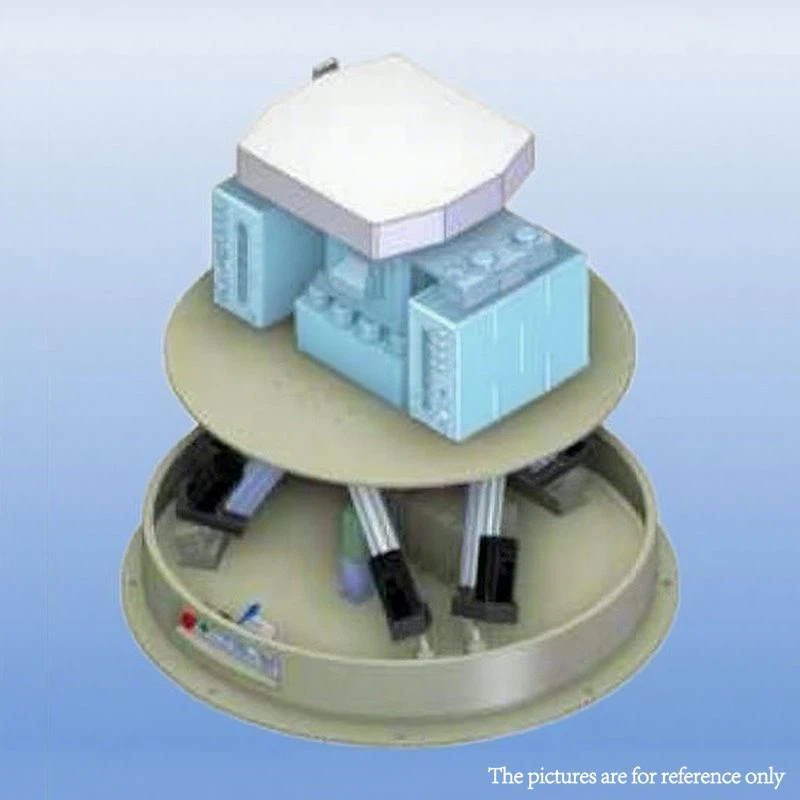
Advanced Detection for High-Density Airspace Monitoring
The Multi-Target Drone Detection Radar is an advanced airspace monitoring solution designed for environments where multiple aerial objects may be present simultaneously.
Powered by dual-band radar technology, AI-driven target classification, and distributed networked sensing, the system provides reliable detection, tracking, and behavior analysis of large numbers of low-altitude aerial objects in real time.
Designed for airports, smart cities, transportation hubs, industrial facilities, ports, and critical infrastructure, the radar delivers comprehensive situational awareness while maintaining high detection accuracy in complex operating environments.
Key Features
High-Capacity Multi-Target Tracking
The radar is specifically optimized for environments with numerous simultaneous aerial objects.
Capabilities include:
Tracking more than 500 targets simultaneously
Real-time trajectory analysis
High-density target monitoring
Continuous object correlation
This makes the system ideal for busy urban environments and large-scale infrastructure projects.
Dual-Band Radar Architecture
The radar operates simultaneously in X-band and Ku-band frequencies.
Benefits include:
Improved detection reliability
Enhanced target recognition
Better environmental adaptability
Increased detection confidence
Data from both frequency bands is automatically fused to improve overall system performance.
AI-Powered Behavior Analysis
Beyond target detection, the system analyzes movement patterns and group behavior.
Capabilities include:
Formation pattern recognition
Coordinated movement analysis
Trajectory correlation
Automated prioritization of unusual activity
This enables operators to focus on the most relevant events in complex airspace environments.
Distributed Multi-Node Monitoring
Multiple radar units can operate as a distributed monitoring network.
Advantages include:
Elimination of coverage gaps
Improved tracking continuity
Multi-angle observation
Extended monitoring areas
The architecture supports large-scale deployments across airports, industrial sites, and smart city projects.
Automatic Sensor Integration
The radar can automatically integrate with:
Electro-optical cameras
Thermal imaging systems
AI video analytics
Centralized monitoring platforms
This allows rapid visual verification and improved operational awareness.
Technical Specifications
| Parameter | Specification |
|---|---|
| Operating Frequency | X-Band / Ku-Band |
| Detection Range | ≥ 5 km (RCS 0.01 m²) |
| Simultaneous Tracking Capacity | ≥ 500 Targets |
| Update Rate | ≥ 20 Hz |
| AI Engine | Group Behavior Recognition & Intelligent Prioritization |
| Networking | Distributed MIMO Multi-Node Architecture |
| Single Node Weight | ≤ 35 kg |
AI-Powered Radar Intelligence
Proprietary AI Radar Processor
The radar incorporates an advanced AI processing engine designed for real-time edge analytics.
Features include:
Inference latency below 5 ms
Ultra-low power consumption
Online software updates
Remote AI model optimization
Continuous performance improvements
Micro-Doppler Classification Engine
The system can classify more than 15 categories of aerial objects.
Supported classifications include:
Drones
Birds
Balloons
Helicopters
Other airborne objects
Classification accuracy exceeds 98.5% under operational conditions.
Real-Time Behavioral Analysis
Advanced deep-learning algorithms analyze:
Flight patterns
Movement consistency
Group coordination
Route anomalies
This provides additional context beyond basic target detection.
Intelligent AI Algorithms
Radar-to-Optical Verification
The system combines multiple verification layers:
Radar Detection → Optical Tracking → AI Visual Verification
This process significantly reduces nuisance alerts and improves confidence in target identification.
Adaptive Resource Management
Using reinforcement learning algorithms, the radar dynamically adjusts:
Beam allocation
Signal waveforms
Tracking priorities
Processing resources
This enables efficient operation in congested airspace environments.
Deep Learning Clutter Suppression
Advanced neural-network algorithms improve signal quality and target visibility.
Benefits include:
Improved signal-to-noise ratio
Better low-altitude target detection
Reduced environmental interference
More stable tracking performance
Built for Continuous Operation
Industrial-Grade Reliability
Designed for 24/7 operation in demanding environments.
Key features include:
MTBF greater than 50,000 hours
Redundant communication architecture
Dual power protection
Lightning and surge protection
Extreme Environmental Performance
The system is engineered for:
High temperatures
Low temperatures
High humidity
Coastal environments
Dust and sand exposure
The phased-array antenna architecture is designed for long-term operational reliability.
Flexible Deployment and Expansion
Mesh Networking Capability
The platform supports:
2–100 node deployments
Wired and wireless hybrid networking
Dynamic node expansion
Distributed monitoring architecture
Multi-Terminal Access
Operators can access system information through:
Web-based monitoring platforms
Desktop workstations
Mobile applications
Tablets
AR-enabled devices
Third-party API integrations
Future-Proof Software Architecture
The system supports:
OTA firmware updates
AI model optimization
Algorithm upgrades
Customized monitoring rules
This ensures long-term scalability and continuous improvement.
Typical Applications
Airport Airspace Monitoring
Supports:
Airport perimeter monitoring
Airspace awareness
Detection of multiple simultaneous aerial objects
Operational safety enhancement
Smart City Projects
Ideal for:
Urban airspace monitoring
Public event protection
Intelligent city infrastructure
Multi-sensor monitoring networks
Critical Infrastructure Protection
Suitable for:
Power plants
Data centers
Utility facilities
Transportation hubs
Industrial parks
Ports and Maritime Facilities
Supports:
Coastal monitoring
Port operations
Maritime infrastructure protection
Low-altitude object awareness
Large Industrial Facilities
Provides enhanced monitoring for:
Manufacturing sites
Energy facilities
Logistics centers
Large campuses
Lower Total Cost of Ownership
The radar is designed to minimize lifecycle expenses.
Benefits include:
Proprietary chip technology reducing hardware costs
Modular maintenance architecture
Remote diagnostics
OTA software updates
Reduced field service requirements
Organizations can achieve significant long-term operational savings.
Service & Support
Pre-Sales Services
Technical consultation
Site assessment
Solution design
Demonstration support
Deployment Services
Installation assistance
System commissioning
Operator training
Acceptance testing support
Warranty & Support
3-Year Manufacturer Warranty
24/7 Remote Technical Support
Fast Response Service
Long-Term Services
Firmware updates
AI model optimization
Preventive maintenance
Spare parts support
Why Choose This Multi-Target Drone Detection Radar?
✔ Simultaneous tracking of over 500 aerial objects
✔ Dual-band radar technology for enhanced detection reliability
✔ AI-powered classification accuracy exceeding 98.5%
✔ Intelligent behavior analysis and activity prioritization
✔ Distributed multi-node networking capability
✔ Automatic optical verification integration
✔ Reduced lifecycle costs
✔ Reliable operation in demanding environments
✔ Continuous software upgrades and technical support
FAQ
What makes this radar different from conventional drone detection systems?
This radar is specifically designed for environments where many aerial objects may be present simultaneously. It can track more than 500 targets while maintaining high classification accuracy.
How many targets can the system monitor at the same time?
The radar supports simultaneous tracking of more than 500 aerial targets, making it suitable for large-scale monitoring applications.
Does the radar use AI for target classification?
Yes. The system incorporates AI-powered micro-Doppler analysis and behavior recognition algorithms capable of classifying multiple types of aerial objects.
Can the radar distinguish drones from birds?
Yes. Advanced AI algorithms enable accurate discrimination between drones, birds, balloons, helicopters, and other airborne objects.
What is the maximum detection range?
The radar can detect targets with an RCS of 0.01 m² at distances exceeding 5 kilometers under typical operating conditions.
Can multiple radar units work together?
Yes. The system supports distributed MIMO networking, allowing multiple radar nodes to operate as a unified monitoring network.
Can the radar integrate with cameras?
Yes. The radar supports integration with electro-optical cameras, thermal imaging systems, and AI video analytics platforms.
Is the radar suitable for airports?
Yes. The system is well suited for airport airspace monitoring, particularly in environments where multiple aerial objects may be present simultaneously.
Can the radar operate in adverse weather conditions?
Yes. Radar performance remains effective in rain, fog, dust, humidity, and other challenging environmental conditions.
What industries typically use this solution?
Common applications include:
Airports
Smart Cities
Ports
Utilities
Transportation Infrastructure
Industrial Facilities
Energy Sites
Critical Infrastructure
Does the system support remote updates?
Yes. Firmware, AI models, and algorithms can be updated remotely to ensure continuous performance improvements.
How can I request pricing or technical information?
Simply contact our team with your project requirements and coverage objectives. Our engineers will recommend the most suitable configuration and provide a customized quotation.
Hot Tags: high-capacity multi-target airspace monitoring radar, China high-capacity multi-target airspace monitoring radar manufacturers, suppliers, factory, Integrated UAV Detection and Countermeasure Device, Portable Anti Drone System, public security jamming system, radio induction and jamming system


