

Intelligent Low Altitude Monitoring Solution for Modern Public Infrastructure
Government buildings and public facilities play an important role in maintaining essential services, administration, and community operations. These locations often include administrative centers, public service facilities, transportation buildings, research institutions, and large public areas that require reliable safety and operational management.
With the rapid growth of commercial drone applications, low altitude airspace management has become an increasingly important consideration for public facilities. Drones are now widely used for photography, surveying, inspection, and other civilian applications, but unexpected drone activities around sensitive public locations may create challenges for facility operators.
An Airspace Security System for Government and Public Facilities provides an intelligent solution for monitoring low altitude airspace and improving awareness of nearby drone activities.
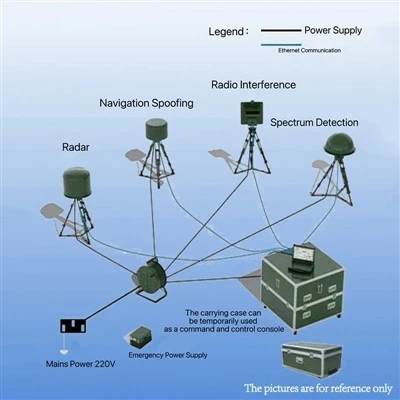
By integrating RF detection, radar monitoring, AI-based recognition, optical imaging, and centralized management platforms, the system helps public facility operators establish a smarter approach to modern airspace monitoring.
Designed for civilian applications, this solution supports government buildings, public service facilities, research centers, transportation buildings, and smart city infrastructure.

Why Public Facilities Need Airspace Monitoring
Modern public facilities often face unique operational requirements that require more comprehensive monitoring capabilities.
Increasing Drone Applications in Public Areas
Drones are increasingly used for civilian purposes, including:
- Building inspection
- Infrastructure surveys
- Photography and media production
- Environmental monitoring
- Public service applications
As drone usage grows, organizations need better awareness of nearby airspace activities.
Important Public Infrastructure Locations
Government and public facilities may include:
- Administrative buildings
- Public service centers
- Research facilities
- Transportation facilities
- Cultural and educational buildings
These locations require effective management of surrounding environments.
Limitations of Traditional Security Systems
Traditional security solutions mainly focus on:
- Personnel access management
- Ground surveillance
- Building protection
- Perimeter monitoring
However, low altitude activities require additional monitoring capabilities.
An airspace security system provides an additional layer of environmental awareness.
Need for Intelligent Facility Management
Modern public infrastructure is becoming increasingly digital.
Facility operators need solutions that can support:
- Automated monitoring
- Centralized management
- Data analysis
- Smart infrastructure development
What Is an Airspace Security System for Government and Public Facilities?
An Airspace Security System for Government and Public Facilities is an integrated monitoring solution designed to improve awareness of low altitude activities around public infrastructure.
The system combines different technologies, including:
- RF drone detection sensors
- Radar monitoring systems
- Optical cameras
- Thermal imaging devices
- AI recognition technology
- Centralized monitoring software
Through multi-source data collection and intelligent analysis, operators can better understand surrounding airspace conditions.
How Public Facility Airspace Security Systems Work
Step 1: Low Altitude Activity Detection
The system continuously monitors surrounding areas using multiple sensing technologies.
Detection methods may include:
RF signal monitoring
Radar-based object detection
Visual observation
This provides information about possible aerial activities.
Step 2: Intelligent Data Analysis
After collecting information, the system analyzes detected activities.
AI-based analysis can support:
- Object classification
- Activity recognition
- Data correlation
- Event management
This improves monitoring efficiency and helps operators understand different situations.
Step 3: Centralized Monitoring and Management
Information from different sensors can be displayed through a unified platform.
Operators can monitor:
- Detection events
- Sensor conditions
- Activity history
- Multiple facility locations
This supports efficient public infrastructure management.
Key Features of Public Facility Airspace Security Systems
Continuous Environmental Awareness
Public facilities often require reliable monitoring due to their operational importance.
Airspace security systems provide additional awareness around:
- Building areas
- Public spaces
- Facility boundaries
- Supporting infrastructure
Multi-Sensor Integration
A comprehensive solution can combine:
RF Detection Technology
Provides awareness of drone communication signals.
Radar Monitoring
Supports aerial object detection.
Optical and Thermal Imaging
Provides visual monitoring capability.
AI Recognition
Improves classification and analysis efficiency.
Flexible Deployment for Different Facilities
Public facilities vary greatly in size and purpose.
Systems can be adapted for:
- Government buildings
- Research institutions
- Public service facilities
- Urban infrastructure
Integration with Smart City Platforms
Modern cities increasingly rely on connected infrastructure.
Airspace monitoring solutions can integrate with:
- Smart city management systems
- Security operation centers
- Video surveillance platforms
- Facility management software

Applications of Airspace Security Systems for Public Facilities
Government Buildings
Administrative buildings may require additional awareness of surrounding low altitude activities.
Airspace monitoring can support:
- Facility management
- Environmental awareness
- Modern security operations
Research Institutions
Research centers often contain valuable equipment and specialized environments.
Monitoring solutions can support:
- Campus management
- Facility monitoring
- Operational awareness
Public Transportation Facilities
Transportation buildings and hubs include:
- Railway stations
- Bus terminals
- Passenger facilities
Airspace monitoring provides additional visibility around these locations.
Smart City Infrastructure
As cities adopt more connected technologies, intelligent airspace management becomes part of broader urban infrastructure development.
Applications include:
- Public infrastructure monitoring
- Urban management platforms
- Digital city solutions
Educational and Cultural Facilities
Large campuses and public venues can benefit from improved low altitude awareness.
Applications include:
- University campuses
- Exhibition centers
- Cultural facilities

Benefits of Airspace Security Systems for Public Facilities
Improved Low Altitude Awareness
Operators gain better understanding of surrounding aerial activities.
Support for Smart Infrastructure Management
The system contributes to more intelligent facility operation.
Reduced Manual Monitoring Requirements
Automated analysis reduces dependence on continuous human observation.
Flexible and Scalable Deployment
Organizations can expand system capabilities according to changing requirements.
Better Integration with Existing Infrastructure
The system can complement existing monitoring and management platforms.
Why Choose an Airspace Security System for Government and Public Facilities?
As public infrastructure becomes more connected and technology-driven, organizations need smarter ways to manage surrounding environments.
An Airspace Security System for Government and Public Facilities provides:
Low altitude airspace monitoring
Multi-sensor integration
Intelligent data analysis
Centralized management capability
Flexible deployment options
For government facilities, public service organizations, and smart city operators, airspace monitoring technology provides a practical solution for improving environmental awareness in the evolving drone era.
FAQ
Hot Tags: airspace security system for government and public facilities, China airspace security system for government and public facilities manufacturers, suppliers, factory