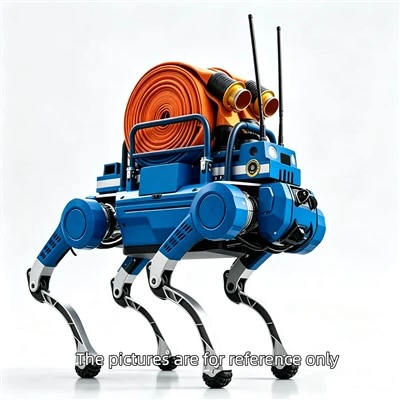
Hey there, everyone! If you’ve been following the world of nuclear power plant tech, you’ve probably seen those badass inspection robotic dogs trotting around reactor containment buildings, checking for leaks, radiation hotspots, and wear on pipes—all without putting human workers in harm’s way. As someone who’s been supplying these four-legged helpers to nuclear facilities for years, one question I get all the time is: “What kind of power source does a nuclear power plant inspection robotic dog even use?”


It’s not like a regular robot vacuum, that’s for sure. Nuclear plants are harsh environments—think high radiation, tight spaces, extreme temperatures, and surfaces that can be slick or slippery from coolant. The power source can’t just be something that runs the motors; it has to be reliable, radiation-resistant, and capable of keeping the bot going long enough to cover a full inspection mission (sometimes 8+ hours) without dying mid-task.
Let’s break this down, real talk. First off, why regular batteries won’t cut it. Your standard lithium-ion battery from a consumer drone? It melts when exposed to high radiation, or its lifespan drops to just a few weeks because the particles zap the chemistry inside. Plus, they don’t hold a charge nearly long enough for a full nuclear plant patrol—you’d be stopping to charge every 2 hours, which is impractical when you need to inspect miles of piping and multiple equipment rooms.
So what do we actually use for our nuclear inspection robotic dogs? Let’s start with the workhorse right now: high-temperature, radiation-hardened lithium-ion phosphate (LFP) batteries. Wait, but why LFP vs. other lithium types? LFP is way more stable—it’s less likely to catch fire, which is a huge deal in a facility with flammable materials (even if we’re extra safe). And when we harden them, we tweak the casing and internal components to block gamma and neutron radiation, so they don’t degrade over time like regular batteries. These bad boys can last up to 12 hours on a single charge, depending on the model, and the robotic dog we sell checks out at /robotic-dog/robotic-dog-for-inspection-and-maintenance/nuclear-power-plant-inspection-robotic-dog.html for more specs, by the way. That long runtime is key because nuclear plant inspections aren’t just a quick walk—they’re thorough, checking every nook and cranny.
But wait, what if the mission is extra long? Like, some plants do 24/7 inspections during outages, where they’re shutting down parts of the plant for maintenance. For those cases, we pair the LFP batteries with a wireless charging system that’s built right into the plant’s infrastructure. It’s not like the charging pad you use for your phone—these are specialized inductive chargers that can handle the radiation. The robotic dog just navigates back to a charging station when it’s low on juice, docks, and tops off while continuing to send data to the control room. No human has to physically plug anything in, which is perfect because moving around a nuclear plant during an outage is restricted. You can see how this works for other industrial inspections too, like oil and gas pipelines, at /robotic-dog/robotic-dog-for-inspection-and-maintenance/robotic-dog-for-oil-pipeline-inspection.html—the tech translates really well, just adapted for nuclear’s stricter rules.
Is there a next-gen power source in the works? Totally. We’re testing small nuclear betavoltaic batteries right now, but I won’t lie, they’re still in the trial phase. Betavoltaics use radioactive isotopes (like tritium) to generate electricity, and they can last for years—like 10-20 years—without needing a charge. But the catch? They produce low power, so right now they can only run small sensors. We’re tweaking the design to boost the output so they can handle a robotic dog’s motors and cameras without overheating. It’s exciting, but we’re not ready to roll that out to clients yet—we want to make sure it’s 100% safe for use around nuclear reactors, no chance of leakage or interference.
Another thing people don’t think about: power management. A robotic dog doesn’t need full power for all systems 24/7. We program them to adjust power usage based on what they’re doing—if they’re moving down a straight hallway, they can dial back the motors a bit and boost the camera when they spot a potential leak. That smart power management is just as important as the battery itself. It’s the difference between a bot that runs for 10 hours and one that runs for 15, which means fewer interruptions during inspections.
Let’s also talk about why this matters for nuclear safety. If a robotic dog loses power mid-inspection, that’s not just an inconvenience. It could miss a small leak that turns into a big problem later, or it might not detect a radiation hotspot that puts workers at risk. So the power source has to be redundant, too. Our models have a small backup battery that kicks in immediately if the main one starts failing—we’re talking milliseconds. No lag, no gaps in data. That’s non-negotiable in this industry.
I’ve been in this game for a while, and I’ve seen how far these robotic dogs have come. A few years ago, people were skeptical that a four-legged bot could handle the uneven floors and tight spaces in a nuclear plant. Now, they’re standard in most commercial facilities. And a big part of that success is getting the power source right. It’s not enough to have a cool robot—if it dies when you need it most, it’s useless.
If you’re curious about how our nuclear inspection robotic dogs work, or if you’re looking to upgrade your facility’s inspection process, hit me up. We’ve helped dozens of plants cut down on human exposure to radiation and improve the accuracy of their inspections. Whether you need a unit for daily patrols or a custom setup for planned outages, we’ve got you covered. For more details on our other inspection robots (like ones for general patrols), check out /robotic-dog/robotic-dog-for-inspection-and-maintenance/robotic-dog-for-inspection.html too—same reliable tech, just adapted for different environments.
At the end of the day, the power source is the backbone of the entire robotic dog. It’s what turns a gadget into a reliable tool that keeps nuclear plants running safely and efficiently. As the industry keeps evolving, we’re working on even better power solutions—more durable, longer-lasting, and even safer. But right now, the radiation-hardened LFP batteries paired with smart charging are the gold standard, and they’ve already made a huge difference for our clients.
References
- Nuclear Energy Institute. (2022). Robotic Technologies for Nuclear Plant Inspections.
- International Atomic Energy Agency. (2021). Radiation-Resistant Equipment for Nuclear Facility Maintenance.
- Industrial Robot Association. (2023). Power Systems for Mobile Inspection Robots in Harsh Environments.