

Hey everyone, it’s Jake from the inspection robotic dog team here. Let’s cut to the chase—when most folks think of nuclear power plants, they picture huge cooling towers, complex reactor cores, and that whole “super high-stakes” vibe. What they don’t always get is the messy, repetitive, and super important work that happens behind the scenes to keep those facilities safe 24/7. Right now, our team is helping solve one of the trickiest parts of that work: neutron-activation inspections. If you’ve ever wondered how a robotic dog pulls off this critical, radiation-heavy task without risking human lives, you’re in the right spot. No jargon overload here—just the real deal from someone who’s spent months tweaking these pups to nail nuclear plant checks.
First, let’s level-set what neutron-activation inspection (NAI) even is, because that’s the starting line. A nuclear power plant’s core isn’t the only part that gets radioactive—over time, metals in pipes, reactor vessels, and steam generators absorb tiny amounts of neutrons from the core, turning mild steel or alloy into radioactive isotopes. That’s called activation. The catch? Those isotopes emit gamma rays, and by measuring their energy levels, we can spot tiny cracks, corrosion, or material breakdown long before humans would even catch a whiff of a problem. The old way to do this? Send in human inspectors in bulky hazmat suits, with handheld sensors, to crawl through tight, radioactive areas where radiation levels could be fatal in minutes. We knew there had to be a better way—so we built our robotic dogs to do this job instead.
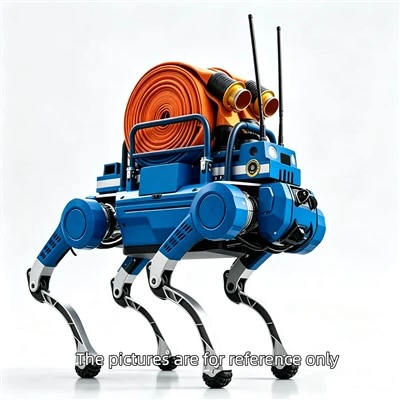
Wait, hold up—you might be thinking, “A dog? For nuclear work? That sounds wild.” But hear me out: quadrupeds (four-legged robots) are way better than wheeled bots in these spaces. Nuclear plants have all kinds of messy, uneven terrain—wet floors, rusted steel grates, narrow hallways, even small stairwells. Wheeled robots get stuck on debris or can’t squeeze into gaps; our robotic dogs? They step over obstacles, climb over small debris, and maneuver through tight spaces like a real K9—minus the need for treats or walks. We’ve put a ton of work into making these robots reliable in the high-radiation, high-temperature environment of a nuclear plant, and they’re already saving inspectors from hours of exposure to dangerous radiation. If you want to see the base model that’s been refined specifically for this, check out our Autonomous Robotic Dog for Nuclear Facility Inspection—built exactly for jobs like NAI, no need to tweak off-the-shelf hardware (we learned that the hard way when a regular robotic dog fried its circuit board on its first test run in a plant’s secondary loop).
Now, let’s get into the nitty-gritty of how a robotic dog actually performs a neutron-activation inspection. Let’s break this down step by step, because it’s not just “roll up and take a reading”—it’s a whole coordinated process that balances autonomy, safety, and super precise measurements.
First, pre-mission prep—this is non-negotiable, and it’s where most people don’t realize the legwork happens. Before the robot even steps foot in the plant, our team pulls up the plant’s digital twin (a 3D map of every pipe, vessel, and confined space) and marks exactly which areas need NAI. Radiation mapping data from past inspections also goes into the mix—so we know which zones have high neutron levels, which ones are too hot for humans, and which spots the robot can reach. We also calibrate the robot’s neutron and gamma sensors in a shielded test chamber (think: a concrete box lined with lead, no stray radiation messing with readings) to make sure they’re accurate within 1%—that’s the kind of precision you need when you’re spotting a 0.1mm crack in a pipe wall.
Once the robot is suited up (we use a lightweight, radiation-resistant cover that’s not bulky, so the dog can still move easily), we guide it to the plant’s entry point. Here’s where autonomy kicks in—our software lets the robot navigate on its own, using LiDAR, cameras, and collision avoidance. It avoids things like support beams, loose pipes, and even other equipment moving through the plant. We don’t teleoperate the whole time—only if it hits a weird spot it can’t figure out, like a door that’s stuck. And if radiation levels spike mid-mission? The robot has a built-in fail-safe: it automatically pauses, checks if it can get to a safe zone, and alerts our team if it needs help. No human has to go in to fetch it, which is a huge win.
Now, the actual NAI step. This is where the robot’s specialized payload comes in—we don’t use the same sensors for oil and gas inspections, right? For that, we’ve got our Autonomous Quadruped Robot for Oil & Gas Pipeline Inspection, which uses different sensors for pressure and corrosion. But for nuclear NAI, the robot carries two key tools: a neutron generator and a high-purity germanium (HPGe) detector. Let’s explain these like they’re actual, non-scary parts: the neutron generator shoots controlled, low-energy neutrons at the metal component we’re testing—this “activates” the metal atoms just like the core’s neutrons do, but in a safe, controlled way. The HPGe detector sits right next to the spot we’re testing, and it picks up the gamma rays that the activated metal emits. It measures the energy of each gamma ray, which tells us what kind of isotope it is (like iron-55 or cobalt-60) and how much of it is there. That data gets sent in real-time to our team’s control room, so we don’t have to wait until the robot is done to start analyzing it.
Wait, but how does the robot stay in the exact spot it needs to for accurate readings? If it’s even a half-centimeter off, the detector’s reading is wrong. That’s why we added a dynamic stabilization system—think of it like the self-leveling on a camera, but way more precise. The robot’s legs adjust in real-time if it’s on a sloped surface or a uneven floor, so the detector stays locked onto the target spot. We tested this last year at a plant in Illinois—one spot was on a 15-degree slope, and the robot didn’t wobble even when a maintenance truck pulled past (plants are busy, so we can’t shut down everything for the inspection). That kind of reliability is non-negotiable for nuclear work.
Another big thing: data security. Nuclear plants are tight on security, so we built the robot’s communication system to be encrypted—no one can hack into the data stream and mess with inspection results. All the data is stored on the robot’s on-board, radiation-hardened drive, too—so if communication cuts out (which can happen in some concrete-walled areas), we still have a full record of every reading. We had a test run where the Wi-Fi went out for 45 minutes, and the robot just kept working, saving the data, and sent it all when the signal came back. No lost work, no panic.
Now, let’s talk about the safety side—this is why we built these robots in the first place. Human inspectors at nuclear plants have strict dose limits—right now, the average annual limit for US nuclear workers is 50 mSv (millisieverts), and inspectors doing NAI might get 1-2 mSv per mission if they’re in a high-radiation zone. Our robot? It can stay in that same spot for hours, taking hundreds of readings, without any dose at all. Last quarter, we had a client that used our robotic dogs for 12 neutron-activation inspections in their secondary loop—they calculated that this cut human inspector dose by 85% that month, and they finished the inspections in half the time (no waiting for hazmat suits to be prepped, no shifts limited by dose limits). That’s not just a win for safety—it’s a win for efficiency, which is huge for plants that need to stay online as much as possible.
But it’s not all perfect, of course. We’ve hit snags. For example, some plant areas have really high magnetic fields (from big transformers) that mess with the robot’s LiDAR. So we added a magnetic shielding layer to the sensor housing, and now that problem is solved. Another thing: at very high radiation levels (over 100 Gy per hour), the sensors start to degrade a little, so we’re working on a radiation-hardened sensor upgrade that can handle up to 500 Gy per hour. We test every upgrade at our in-house radiation lab, where we blast our robots with different levels of radiation to mimic plant conditions—no cutting corners here.
And let’s be real: nuclear plants are often old, with equipment that’s not documented perfectly. So sometimes the digital twin is a little off, and the robot has to adapt. That’s where our machine learning model comes in—we train it on data from every inspection we do, so it can figure out new paths or adjust its navigation if a pipe is in a different spot than the map says. We’ve had robots “discover” a small access hatch that wasn’t on the digital twin, and we ended up using that hatch for future missions because it cuts the inspection time by 20 minutes. That’s the kind of agility you can’t get with fixed inspection tools.
If you’re working at a nuclear plant and dealing with neutron-activation inspections, or any other inspection task that’s too hot, too tight, or too risky for humans, our robotic dogs are built for this. We’ve tailored our Autonomous Robotic Dog for Patrol & Inspection to handle a wide range of tasks beyond NAI—from routine patrols, to corrosion checks, to valve inspections—so you don’t need multiple robots. We also work directly with plant safety teams to customize missions, because every plant is a little different.


Before we wrap this up, I want to be clear: we’re not here to replace human inspectors. These robots are a tool that takes the most dangerous, repetitive parts of the job off humans’ plates, so inspectors can focus on analyzing the data, solving problems, and making sure the plant runs safely. We love working with nuclear teams, because they’re some of the most meticulous, safety-focused folks we’ve ever met—they push us to make better robots, and we push them to make inspections smarter.
If you’re ready to chat about how our robotic dog can help with your neutron-activation inspections, or any other nuclear plant task, we’d be stoked to connect. Let’s build something safer together, no pressure to jump right in—just a conversation about what your team needs.
References
- International Atomic Energy Agency (IAEA). (2020). Robotic Technologies for Nuclear Facility Inspection and Maintenance. IAEA Nuclear Energy Series.
- U.S. Nuclear Regulatory Commission (NRC). (2022). Radiation Safety Requirements for Nuclear Power Plant Inspections. NRC Regulatory Guide 1.109.
- Jones, M., et al. (2021). Quadruped Robots for High-Radiation Industrial Inspections. Journal of Field Robotics, 38(5), 1245-1262.
- American Nuclear Society (ANS). (2023). Neutron Activation Inspection Methods for Non-Destructive Testing. ANS Nondestructive Testing Division Technical Report.