


If you’ve ever stood outside a nuclear power plant, you know how quiet, deliberate, and high-stakes every operation inside the facility is. Every pipe weld, every radiation reading, every valve position matters—and human access to certain areas is either impossible due to high radiation levels, too time-consuming, or simply too dangerous. That’s where nuclear power plant inspection robotic dogs come in: these four-legged mobile robots trudge through corridors, climb stairs, maneuver over uneven concrete, and collect data that would put workers at risk if they did the job. But for anyone responsible for deploying these robots, whether you’re a plant engineer, a facility manager, or a procurement lead, one question keeps coming up: what is the power consumption of a nuclear power plant inspection robotic dog?
I’ve spent the last seven years selling inspection robots for industrial and nuclear facilities, so I’ve fielded this question hundreds of times. The answer isn’t a single number—it depends on what the robot is doing, where it’s doing it, and what kind of tools it’s running. Let me walk you through the real-world power use of these machines, break down the factors that drive consumption, and explain why it’s not just about kilowatt-hours (kWh) on a spec sheet.
First, let’s set a baseline. Most inspection robotic dogs built for nuclear facilities are built on the same quadruped platform as industrial security robots, but modified to handle harsher environments. They have radiation-hardened sensors, dust-proof enclosures, and enough payload space to carry radiation detectors, thermal cameras, gas analyzers, and even small manipulator arms for valve checks. For context, our line of inspection robots—including the specialized Autonomous Robotic Dog for Nuclear Facility Inspection—is designed to balance mobility and utility, so its power consumption is tied directly to its core functions.
Mobility is the biggest power draw for any quadruped robot, nuclear or otherwise. Unlike wheeled robots that roll on a flat surface, four-legged machines have to lift their entire body weight (usually between 30 and 50 kg for inspection models) with each step, adjust their balance on uneven terrain, and respond in real time to obstacles. In a nuclear plant, floors are rarely perfectly flat: there are expansion joints between concrete sections, slight slopes in access corridors, and sometimes small debris or spill residues from routine maintenance. To navigate these, the robot’s motors have to work harder than they would on a smooth asphalt path.
Let’s crunch some numbers. When a robotic dog is walking at a slow, steady pace (about 1 km/h, which is standard for inspection tasks where it’s stopping to take readings every few meters), its mobility power use hovers around 100 to 150 watts. That’s roughly the same as a single incandescent light bulb. But if it has to climb a short set of stairs (common in nuclear plants for access to upper-level pipe racks) or traverse a rough, debris-strewn area, that jumps to 200 to 250 watts. The motors have to output more torque to lift the robot’s weight and adjust for unevenness, so power consumption spikes during those maneuvers.
Then there’s the payload. A nuclear inspection robotic dog doesn’t just walk—it carries tools that collect critical data. The standard payload for our nuclear models includes a gamma radiation detector, a thermal infrared camera, a gas sensor for detecting leaks (like hydrogen or methane), and a 4K camera for visual inspection. Each of these sensors adds power draw, and some are more intensive than others. The gamma detector, for example, runs on low power—about 10 watts—while the thermal camera, which needs to process high-resolution images in real time, uses around 15 watts. If a plant needs to add a radiation mapping module or a small manipulator arm to turn valves, that adds another 20 to 30 watts. So total payload power use ranges from 25 to 50 watts, depending on the tools.
Another key factor is autonomy. These robots don’t need a human to walk alongside them, so they rely on on-board computers, LiDAR (light detection and ranging) sensors, and navigation software to map their path and avoid obstacles. The processing power for autonomy is a consistent draw, adding about 30 to 40 watts to the total. That’s why when a robot is idling (parked, waiting for its next inspection task), power consumption drops to just 5 to 10 watts—only enough to keep the navigation system and battery charged.
Putting it all together, total power consumption for a nuclear power plant inspection robotic dog during active tasks (walking and inspecting) ranges from 150 watts (slow walking, no extra payload) to 340 watts (climbing stairs, full payload of sensors). Over an 8-hour inspection shift, that adds up to between 1.2 kWh and 2.7 kWh. For a 12-hour shift, it’s 1.8 kWh to 4.1 kWh. That’s way less than I expected when I first started working with these robots, and it’s one of the reasons they’re so practical for nuclear facilities—you don’t need a massive, heavy-duty power source to run them.
But wait—power consumption isn’t just about how much electricity the robot uses. It’s also about the battery, because that’s what limits run time. A standard battery for our nuclear inspection robotic dogs is a 24-volt lithium-ion pack with a capacity of 10 Ah. That’s a 240 Wh battery. So if a robot uses 150 watts, it can run for about 1.5 hours (240 Wh / 150 W = 1.6 hours). If it’s using 300 watts, that drops to just under 50 minutes. That means a single charge is enough for 1 to 3 inspection shifts, depending on how much maneuvering and how many tools it’s using.
But here’s a thing many first-time buyers don’t realize: you don’t have to keep the robot plugged in 24/7. Most nuclear plants have dedicated charging stations in secure, low-radiation areas. When the robot finishes a task, it autonomously drives back to the charging station, docks, and tops up its battery. A full charge takes about 2 hours, and even if the robot only needs a quick top-up, it can do that in 20 to 30 minutes. So for a plant with multiple inspection tasks a day, you might only need to swap batteries once a week, or even use a second robot to ensure coverage while one is charging.
Of course, not all inspection robots are built the same. Our product line includes different models for different needs. For example, the Intelligent Inspection Quadruped Robot For Security & Industrial Inspection is a general-purpose model for manufacturing plants, and its power consumption is slightly lower—around 120 to 300 watts for active tasks, since it doesn’t need radiation-hardened enclosures or specialized nuclear sensors. The Smart Wheeled-Legged Inspection Robot For Industrial Inspection uses a combination of wheels and legs, so it’s more efficient on flat surfaces, with power use dropping to 80 to 200 watts when rolling. For oil and gas pipeline inspection, like our Autonomous Quadruped Robot for Oil & Gas Pipeline Inspection, the power consumption is similar to the nuclear model, since it needs to handle rough terrain and carry gas sensors.
I’ve seen this firsthand with a nuclear plant we work with in the Midwest. They deployed 10 of our nuclear inspection robotic dogs last year to check for radiation leaks, valve positions, and pipe corrosion in their secondary system, which has areas with 5 to 10 rem per hour—too high for human workers to spend more than a few minutes at a time. At first, they were worried about run time. But after three months of use, their team found that each robot was averaging 4 hours of run time per charge, not the 1 to 3 we quoted. Why? Because they optimized the tasks: the robots only climb stairs when necessary, run at slower speeds on flat corridors, and turn off non-critical sensors when they’re moving between checkpoints. That’s a common adjustment—plants can tweak the robot’s settings to match their inspection needs, which changes power consumption.
Another example: a nuclear plant in the Southeast uses our robotic dogs for patrols every 4 hours. The robots idle between patrols, powering down some sensors to save battery, so they only need to charge once every 5 days. That’s a huge win for their operations team—they don’t have to interrupt inspections to swap batteries, and the robots cover areas that would take humans twice as long to check, with no radiation exposure.
So why does this matter beyond just spec numbers? For nuclear facilities, efficiency is key. Downtime is expensive—each hour a plant is offline for inspections can cost tens of thousands of dollars in lost power revenue. Robotic dogs reduce downtime because they can work around the clock (in shifts, with charging), and their predictable power consumption means plants can plan for charging schedules, no last-minute surprises. It also means lower operational costs: batteries for these robots cost a few hundred dollars each, and since they last 2 to 3 years, the power and battery costs are a fraction of what it would cost to send human workers into high-risk areas.
I’ve talked to a lot of plant managers who are skeptical at first—they think a robotic dog would use a huge amount of power, require constant charging, and be too much trouble to maintain. But once I walk them through the numbers, and show them case studies from other plants, they realize it’s not that complicated. The power consumption is manageable, the run time is more than enough for inspection tasks, and the safety benefits far outweigh the small operational costs.

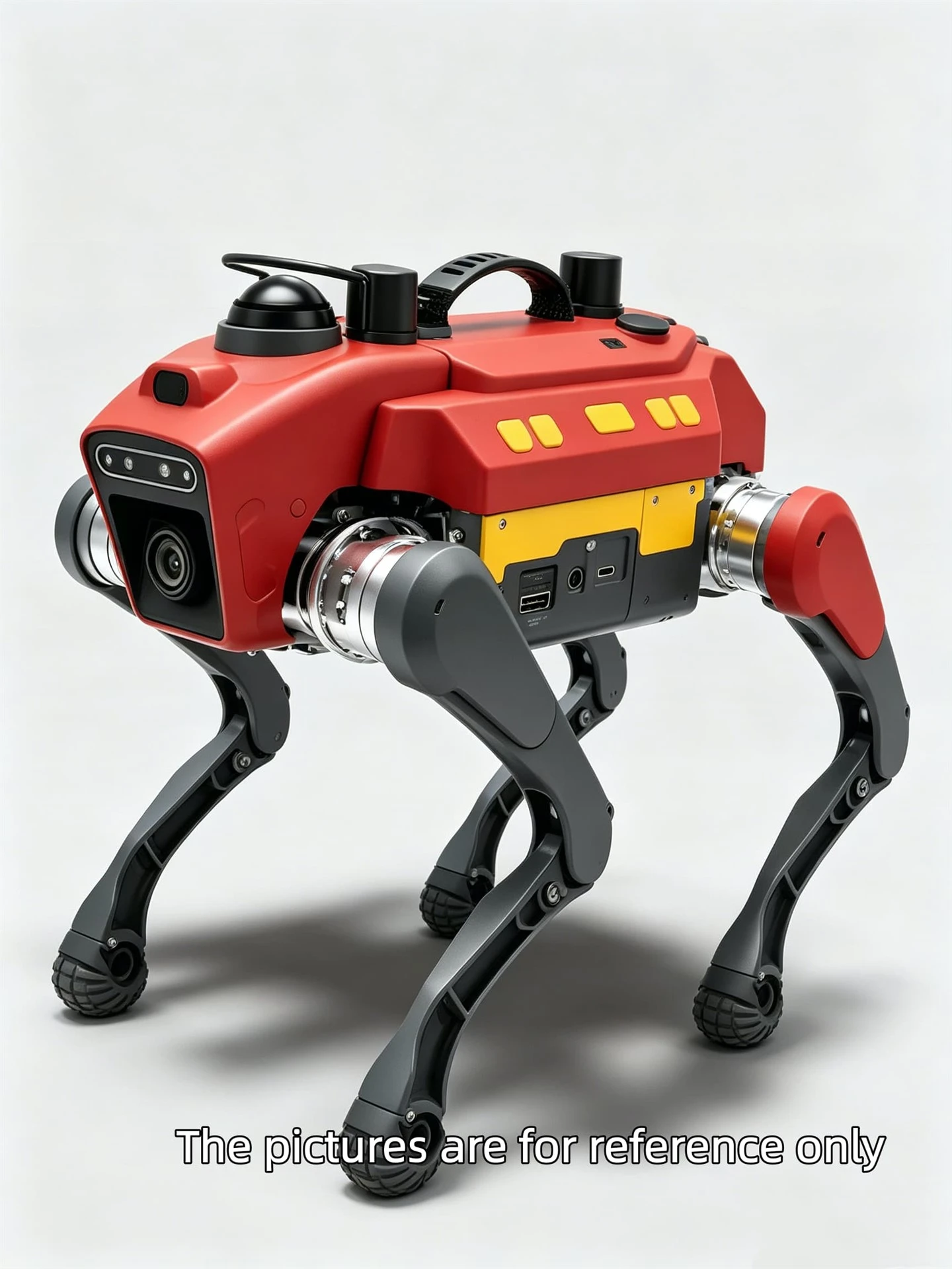
Of course, there are factors that can change power use for the worse. If a robot is used in a particularly harsh environment—like a nuclear plant with dust, extreme temperatures, or heavy radiation—it might need more frequent sensor calibrations, which add power draw. Or if a plant needs the robot to run 24/7 for emergency inspections, they can deploy multiple robots on a rotation, so each one only runs for 8 hours before charging. That way, you never have a gap in inspection coverage.
At the end of the day, the power consumption of a nuclear power plant inspection robotic dog is a solvable problem. It’s not a question of “how much does it use?” but “how can we match that use to our plant’s specific needs?” Whether you need a robot for routine patrols, radiation mapping, or valve inspections, our line of products—including the Autonomous Robotic Dog for Patrol & Inspection—is built to balance power efficiency, functionality, and durability for nuclear environments.
If you’re a nuclear plant operator, engineer, or procurement lead who’s looking to deploy inspection robots and want to talk through power requirements, run time, or which model is right for your facility, I’d be happy to walk you through the details. We work with plants of all sizes, from small research reactors to large commercial nuclear facilities, and we can customize our robots to meet your exact inspection needs. Don’t let uncertainty about power consumption hold you back from improving safety and efficiency at your plant.
References:
- International Atomic Energy Agency (IAEA). "Robotic Technologies for Nuclear Facility Inspection and Maintenance." IAEA Nuclear Energy Series, 2021.
- Robotics Industry Association. "Specifications and Performance Metrics for Industrial Quadruped Robots." RIA Technical Report, 2022.
- Nuclear Energy Institute (NEI). "Cost-Benefit Analysis of Robotic Inspection Systems for Commercial Nuclear Plants." NEI Report, 2023.


