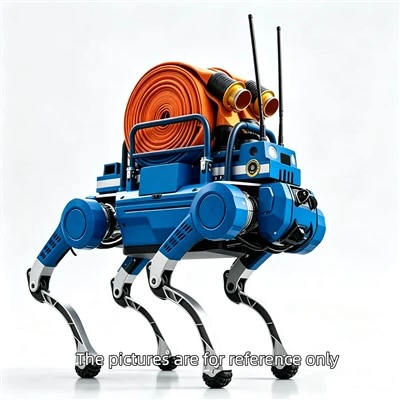
Yo, folks! I'm a supplier of robotic dogs, and today I wanna chat about how these cool machines detect obstacles. It's a super important feature that makes our robotic dogs useful in all sorts of situations, from smart city infrastructure to logistics.
Let's start with the basic sensors that our robotic dogs are equipped with. One of the most common sensors is the ultrasonic sensor. It works in a way similar to how bats use echolocation. The sensor emits ultrasonic waves, which are high - frequency sound waves that humans can't hear. When these waves hit an obstacle, they bounce back to the sensor. By measuring the time it takes for the waves to return, the robotic dog can calculate the distance to the obstacle.
For example, if the ultrasonic wave takes a short time to come back, it means the obstacle is close. On the other hand, if it takes longer, the obstacle is farther away. This simple yet effective method helps the robotic dog quickly get an idea of what's in its path.
Another key sensor is the infrared sensor. Infrared sensors work by emitting infrared light. When this light hits an object, some of it is reflected back to the sensor. The sensor can then analyze the reflected light to determine the presence and distance of the obstacle. Infrared sensors are great for detecting objects in close - range and are very sensitive. They're especially useful in environments where there might be a lot of small objects or when the robotic dog needs to navigate in tight spaces.
Now, let's talk about lidar sensors. Lidar stands for Light Detection and Ranging. These sensors are like the high - tech version of ultrasonic and infrared sensors. A lidar sensor emits laser beams in multiple directions. As these laser beams hit objects in the environment, they bounce back to the sensor. The lidar sensor then measures the time it takes for the laser beams to return and creates a 3D map of the surrounding area.
This 3D map is incredibly detailed and accurate. It allows the robotic dog to not only detect obstacles but also understand their shape and size. Lidar sensors are often used in applications where the robotic dog needs to perform complex navigation tasks, such as Autonomous Smart Grid Inspection & Utility Intelligence Platform. In a smart grid environment, the robotic dog needs to be able to navigate around power lines, transformers, and other equipment safely.
Cameras are also an important part of the obstacle - detection system. Our robotic dogs are equipped with high - resolution cameras that can capture images and videos of the surroundings. Computer vision algorithms are then used to analyze these images. These algorithms can identify different types of objects, such as walls, people, and vehicles.
For instance, if the camera detects a person walking in front of the robotic dog, the computer vision algorithm can recognize the shape of the person and determine the distance. Based on this information, the robotic dog can adjust its path to avoid a collision. Cameras are also useful for long - range obstacle detection and for providing a more comprehensive view of the environment.
But it's not just about having these sensors. The real magic happens when the data from all these sensors is combined. Our robotic dogs use a process called sensor fusion. Sensor fusion takes the data from the ultrasonic sensors, infrared sensors, lidar sensors, and cameras and integrates it into a single, unified view of the environment.
By combining the data, the robotic dog can get a more accurate and detailed understanding of the obstacles in its path. For example, if the lidar sensor detects an object in the distance, the camera can then provide more information about the nature of that object. And the ultrasonic and infrared sensors can be used to double - check the distance and make sure the robotic dog doesn't get too close.
This multi - sensor approach makes our robotic dogs incredibly reliable when it comes to obstacle detection. Whether it's Autonomous Urban Traffic Monitoring & Mobility Intelligence Platform or Autonomous Quadruped Robot for Oil & Gas Pipeline Inspection, our robotic dogs can navigate through complex environments with ease.
In addition to sensor fusion, our robotic dogs also use machine learning algorithms. These algorithms are trained on large datasets of different obstacles and scenarios. As the robotic dog encounters new situations, the machine learning algorithms can adapt and make better decisions.
For example, if the robotic dog is in an area with a lot of moving objects, the machine learning algorithm can predict the movement of these objects and plan a safe path accordingly. This ability to learn and adapt makes our robotic dogs more intelligent and efficient in obstacle detection.
Our robotic dogs are also designed to be flexible in their obstacle - detection strategies. Depending on the application, the robotic dog can prioritize different sensors. For example, in a dark environment, the infrared sensors might be more important, while in an open space, the lidar sensor could take the lead.
The obstacle - detection system in our robotic dogs is also constantly updated. We're always improving the algorithms and adding new features to make the robotic dogs even better at detecting obstacles. This ensures that our customers get the most reliable and up - to - date technology.
Now, you might be wondering where our robotic dogs can be used. Well, they have a wide range of applications. In the field of critical infrastructure security, our robotic dogs can patrol areas and detect any potential threats. Check out Robotic Dog For Critical Infrastructure Security to learn more about how they can be used in this area.
In the logistics industry, our robotic dogs can be used for material transport. They can navigate through warehouses, avoiding obstacles like pallets and other equipment. You can find more details on Robotic Dog for Logistics & Material Transport.


So, if you're in the market for a reliable robotic dog with advanced obstacle - detection capabilities, look no further. Our robotic dogs are designed to meet the needs of various industries. Whether you're in the smart city, inspection, logistics, or security business, our robotic dogs can provide a cost - effective and efficient solution.
If you're interested in learning more or starting a procurement discussion, feel free to reach out. We're here to answer all your questions and help you find the best robotic dog for your specific requirements.
References
- Murphy, R. R. (2000). Introduction to AI robotics. MIT press.
- Thrun, S., Burgard, W., & Fox, D. (2005). Probabilistic robotics. MIT press.