


Short Description
Keep Personnel at a Safe Distance During Hazardous Operations
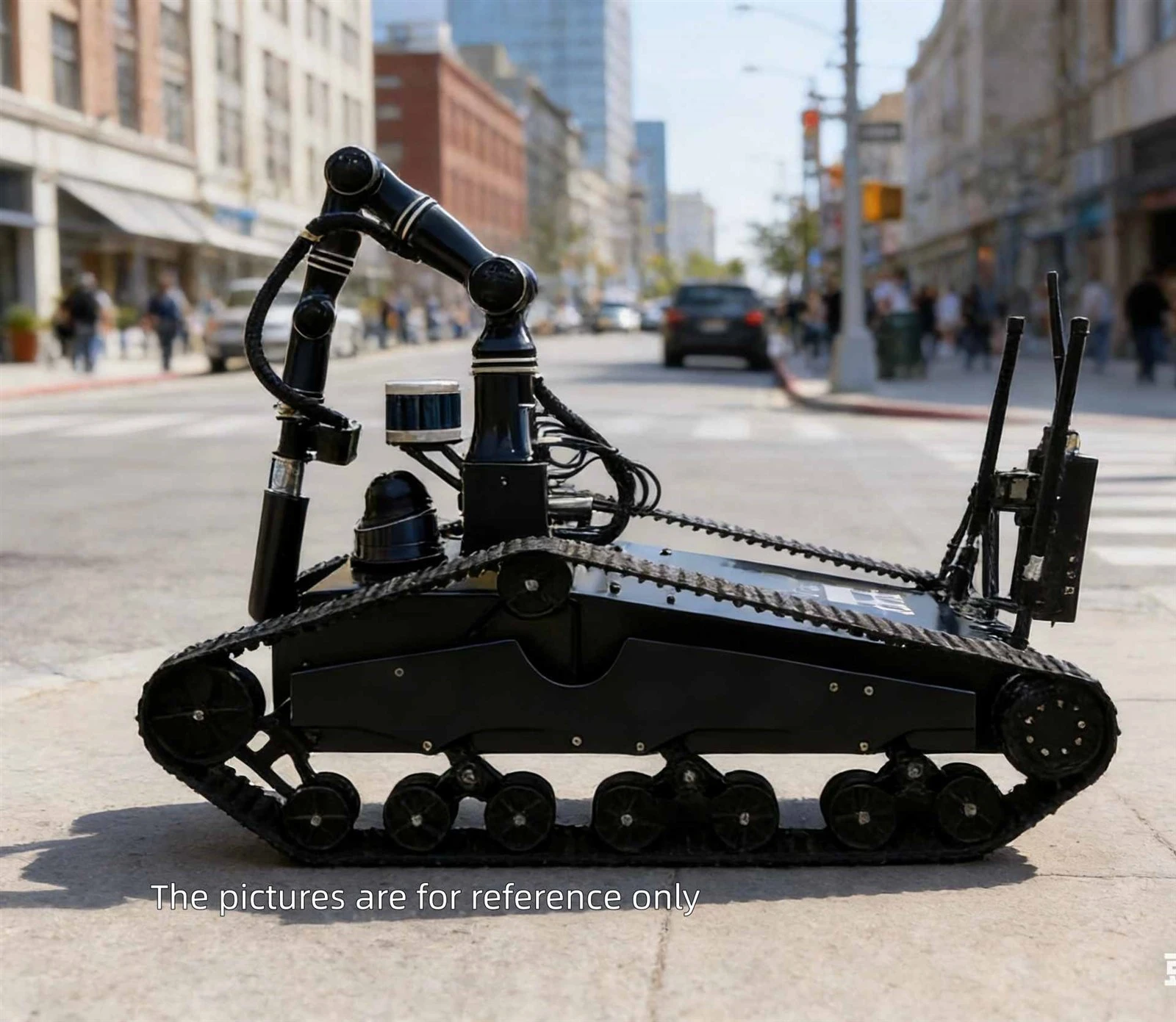
Tracked EOD robotic platform designed for explosive hazard inspection, suspicious object handling, remote reconnaissance, and dangerous environment response.
When Every Meter of Distance Matters, Robotics Protect the Operator
Advanced tracked EOD robot for remote hazardous operations, real-time situational awareness, and high-risk response missions.
Hazardous Threats Require Remote Operations
Explosive threats and suspicious objects create environments where direct human approach can significantly increase operational risk.
Modern EOD and hazardous response teams increasingly rely on robotic systems to:
Increase operator safety
Improve standoff distance
Enhance remote situational awareness
Reduce direct exposure during inspections
Remote EOD robotics are becoming essential tools in public safety and hazardous response operations.
The Solution: Tracked Robotic Hazard Response Platform
Our tracked EOD robotic platform supports:
Remote reconnaissance
Suspicious object inspection
Manipulator-assisted handling
Real-time video transmission
Hazardous environment operations
Helping operators maintain safer operational distance while improving response capability.
PRODUCT DETAIL

The Tracked Robotic Platform for Explosive Hazard Response is designed for handling explosives and high-risk items in hazardous environments. Equipped with a robust tracked chassis, advanced remote control system, and a multi-functional manipulator arm, it ensures stable performance on challenging terrain.
Featuring a high-resolution video system and specialized tools for gripping, cutting, and neutralizing threats, the robot enables precise detection and disposal of suspected explosive devices. It is ideal for use by police, security units, and emergency response teams.
Built for Remote Hazardous Operations
Remote Hazard Inspection
Supports remote inspection of:
Suspicious packages
Hazardous objects
Restricted-access environments
Dangerous operational areas
Tracked Mobility for Complex Terrain
Tracked platform enables movement across:
Stairs
Debris
Gravel
Uneven surfaces
Urban obstacles
Tracked robots are widely preferred in EOD operations because of superior mobility and stability.
Manipulator Arm for Remote Interaction
Supports:
Object handling
Remote manipulation
Hazard inspection assistance
Precision operational tasks
Modern EOD robots increasingly emphasize manipulator precision and operator control feedback.
Real-Time Situational Awareness
Integrated systems may include:
HD cameras
Thermal imaging
Zoom observation
Remote audio/video transmission
High-quality real-time transmission is increasingly critical for EOD operations.
Modular Payload Integration
Supports integration of:
EO/IR systems
Radiation detectors
Gas sensors
Specialized mission payloads
Modern EOD robots increasingly adopt modular multi-sensor architectures.
Manual Hazard Response vs Robotic EOD Operations
| Manual Operations | Robotic EOD Operations |
|---|---|
| Direct operator exposure | Remote operation capability |
| Limited safe distance | Increased standoff distance |
| Reduced visibility | Real-time situational awareness |
| Higher operational risk | Improved personnel safety |
| Limited terrain access | Tracked mobility capability |
Robotics Extend Human Safety Into Dangerous Areas
Why Choose Astral Route
Designed for Hazardous Operations
Built for environments where direct personnel access may not be safe.
Tracked Mobility for Real-World Terrain
Reliable movement across stairs, debris, uneven ground, and confined operational areas.
Advanced Remote Situational Awareness
Integrated HD monitoring improves operational visibility and remote decision-making.
Manipulator Capability for Remote Interaction
Supports precision handling and safe-distance operational tasks.
Reduce Operator Exposure Risk
Improve operational safety by enabling remote hazardous inspection and response.
Protect Operators by Extending Remote Capability
Technical Specifications
Overall Dimensions: Not greater than 1200mm × 800mm × 1000mm
Total Weight: Not greater than 80kg (including mounted equipment and control terminal)
Climbing Capability (Unidirectional Slope): Not less than 30°
Single Run Distance: Not less than 1000 meters (horizontal straight-line distance)
Operating Speed: 0.5 m/s to 2 m/s, adjustable at intervals
Single Operation Endurance: >120 minutes; battery can be replaced for extended operation
Obstacle Clearance Height: Not less than 150mm
Communication Range Extension: Supports carrying and deploying relay devices to extend communication distance
Radiation Resistance – Total Dose: 50 Gy
Radiation Resistance – Instantaneous Dose Rate: 50 Gy/h

Product Features
Hardened radiation tolerance technology
To meet the demands of the operational environment for nuclear, biological, and chemical (NBC) reconnaissance robots, a radiation shielding design is developed using radiation-resistant computational models and the Monte Carlo simulation method to determine optimal shielding materials and thicknesses. Radiation-hardened chips are also selected to design the main control module, ensuring stable operation under high-radiation conditions.
NBC Detection Technology
Following a modular design philosophy, the system provides multiple reserved interfaces to allow flexible integration of various detection modules. This enhances the robot's adaptability to diverse operational scenarios.
Its applications: Designed for Hazardous Security Operations
Explosive Hazard Inspection
Suspicious object assessment
Safe-distance inspection
Remote reconnaissance
Public Safety Operations
Security incident response
Hazardous area investigation
Remote operational support
Critical Infrastructure Security
Transportation hubs
Government facilities
Restricted operational zones
Industrial Hazardous Environments
Dangerous confined spaces
Chemical facilities
High-risk industrial inspection
Emergency Response Missions
Disaster response
Unsafe structural environments
Hazardous debris inspection
Every Additional Meter of Distance Can Improve Operator Safety
Use Cases
Suspicious Object Inspection
Challenge
Security personnel must assess a suspicious object without direct exposure.
Solution
Tracked EOD robot performs remote visual inspection and manipulator-assisted interaction.
Result
Increased standoff distance
Reduced operator exposure
Improved operational safety
Urban Hazardous Operations
Challenge
Complex urban environments create mobility challenges during hazardous response missions.
Solution
Tracked robotic platform navigates stairs and uneven terrain for remote reconnaissance.
Result
Improved terrain adaptability
Better operational reach
Enhanced situational awareness
Industrial Hazard Inspection
Challenge
Hazardous industrial areas require remote inspection capability.
Solution
Robot equipped with cameras and sensors performs preliminary site assessment.
Result
Reduced personnel exposure
Faster hazard evaluation
Improved operational visibility
Emergency Response Deployment
Challenge
Emergency teams require rapid remote awareness in dangerous environments.
Solution
Portable tracked robot provides live operational video and remote interaction capability.
Result
Faster situational assessment
Improved response coordination
Enhanced personnel safety
Contact Us and
Reduce Operator Risk
Improve Remote Hazard Response
Build Your EOD Robotics Capability
FAQ
Q1: What is a tracked EOD robot used for?
It is designed for remote hazardous inspection, suspicious object handling, explosive threat response, and dangerous environment operations.
Q2: Why are tracked platforms preferred for EOD robots?
Tracked mobility improves movement across stairs, debris, uneven surfaces, and difficult terrain.
Q3: How does the robot improve operator safety?
It increases standoff distance and reduces the need for direct human exposure during hazardous operations.
Q4: Can the robot transmit live video?
Yes. Real-time HD video transmission supports remote situational awareness and operational coordination.
Q5: What payloads can be integrated?
Thermal cameras, EO/IR systems, radiation detectors, gas sensors, and specialized mission payloads.
Q6: Is the robot suitable for public safety operations?
Yes. It supports hazardous inspection, suspicious object assessment, and remote operational response.
Q7: Can the robot operate in complex urban environments?
Yes. The tracked design improves mobility in stairs, rubble, and confined operational spaces.
Q8: Why are EOD robots becoming increasingly important?
Organizations increasingly use robotic systems to improve personnel safety and operational effectiveness in hazardous environments.
Hot Tags: Tracked Robotic Platform for Explosive Hazard Response, China Tracked Robotic Platform for Explosive Hazard Response manufacturers, suppliers, factory, public security tracked robots, Tracked Explosive Ordnance Disposal EOD Robot, tracked robot


