

Industrial inspection is moving toward increasingly autonomous systems. A quadruped robot can already navigate stairs, uneven terrain, confined spaces, and complex industrial environments, but mobility is only part of its value. The real potential comes from the sensors it carries.
Radiation detection payloads are one of the most practical sensor options for robotic inspection in nuclear facilities, industrial radiography, research environments, and other controlled areas where radiation monitoring is required.
By mounting radiation detection equipment on a quadruped robot, operators can collect measurements remotely while keeping personnel away from potentially hazardous locations.
This combination of robotics and radiation monitoring is opening up new possibilities for safer and more efficient inspection workflows.
Why Put Radiation Detection Equipment on a Quadruped Robot?
Radiation surveys are traditionally performed by trained personnel carrying handheld instruments. This remains an effective approach for many routine tasks, but some environments are difficult, time-consuming, or unsafe to access.
A robotic platform can provide an additional layer of operational flexibility.
A quadruped robot equipped with a radiation detection payload can enter areas such as:
Nuclear facility inspection zones
Industrial radiography work areas
Contaminated industrial spaces
Restricted maintenance areas
Chemical and process facilities
Disaster or emergency response locations
The robot can transmit radiation measurements and visual information to a remote operator. This allows personnel to assess the environment before deciding whether physical access is necessary.
Types of Radiation Detection Payloads
The appropriate payload depends on the radiation source and inspection objective. There is no single detector that fits every application.
Gamma Radiation Detection
Gamma detectors can be used to identify and measure gamma radiation in industrial and nuclear environments.
When mounted on a robotic dog, gamma detection equipment can support:
Area radiation surveys
Hotspot identification
Remote inspection
Nuclear facility monitoring
Post-incident assessment
Combining gamma measurements with the robot's camera feed can help operators understand where elevated readings are occurring.
Neutron Radiation Detection
Neutron monitoring is important in environments involving neutron sources, nuclear facilities, and certain specialized industrial applications.
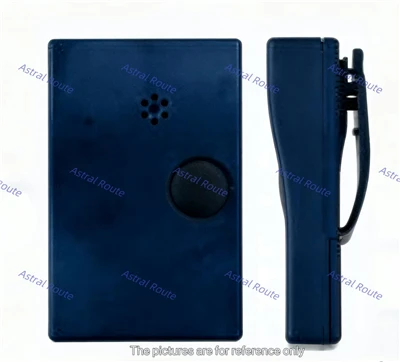
A neutron radiation dosimeter or detector mounted on an industrial robotic platform can provide remote measurements without requiring an operator to immediately enter the area.
For missions involving mixed radiation fields, a combined neutron and gamma detection system may provide more useful information than a single-purpose detector.
Surface Contamination Monitoring
Surface contamination monitoring is another potential application.
A robotic platform can carry contamination detection equipment to survey floors, equipment surfaces, or designated inspection areas.
This can be particularly useful when operators need to investigate potentially contaminated locations while minimizing unnecessary personnel exposure.
Advantages of Robotic Radiation Monitoring
The main advantage is not simply automation. It is the ability to move radiation detection equipment into places where humans may prefer not to go.
Reduced Personnel Exposure
A robotic dog can perform preliminary radiation surveys remotely. If elevated radiation is detected, operators can evaluate the data before sending personnel into the area.
This approach supports the basic radiation protection principle of minimizing unnecessary exposure.
Mobile Measurement
Fixed radiation monitors provide continuous readings at predetermined locations, but they cannot move around a facility.
A quadruped robot provides mobility, allowing radiation measurements to be collected at different locations along a patrol route.
Combining Radiation and Visual Data
Radiation readings become more useful when they can be associated with a specific physical location.
A robotic dog can combine detector data with:
Live video
Thermal imaging
LiDAR mapping
Position information
Environmental sensors
This creates a more complete picture of the inspection environment.
Industrial Applications
Radiation detection payloads for quadruped robots can support several specialized industries.
Nuclear Facilities
Nuclear facilities are one of the most obvious applications. Robotic systems can support remote surveys, maintenance preparation, and inspection of areas where radiation levels need to be assessed before personnel entry.
Industrial Radiography
NDT contractors working with X-ray or gamma radiography equipment may use mobile robotic platforms for specific site-monitoring tasks. A robotic dog can potentially provide additional radiation awareness around complex inspection areas.
Emergency Response
Following an industrial incident, radiation levels may be unknown. Sending a robotic platform equipped with a suitable detector can provide an initial assessment while reducing immediate exposure risks for response personnel.
Research and Specialized Facilities
Research laboratories and other controlled environments may also benefit from mobile radiation monitoring where flexible inspection routes are required.
What Should Buyers Consider?
Selecting a radiation detection payload for a quadruped robot requires more than checking the detector's measurement range.
Important considerations include:
Radiation type
Detector sensitivity
Measurement range
Weight and dimensions
Power consumption
Communication interface
Data logging capability
Environmental protection
Robot payload capacity
Calibration requirements
Mechanical integration is also important. The detector should be securely mounted without interfering with the robot's movement, balance, or other sensors.
Software integration deserves equal attention. Ideally, radiation readings should be synchronized with the robot's position and inspection data rather than displayed as an isolated measurement.
The Future of Robotic Radiation Detection
The combination of AI, autonomous navigation, and radiation sensing could make robotic radiation surveys considerably more useful.
Future systems may automatically follow inspection routes, identify abnormal readings, mark radiation hotspots on facility maps, and return to a charging station after completing a mission.
The goal is not to remove trained radiation professionals from the process. Instead, the robotic platform can handle mobility and data collection while qualified personnel remain responsible for interpretation, safety decisions, and response procedures.
For industrial operators, this human-machine approach may provide a practical balance between automation and radiation safety.
See customized solutions for you at https://www.astralroutetech.com/robotic-dog/
FAQ
Can a robotic dog detect radiation?
Yes, provided that an appropriate radiation detector is integrated as a payload. The robot itself does not inherently detect radiation; the detection capability comes from the mounted sensor.
What types of radiation can a quadruped robot monitor?
Depending on the payload, a robotic platform can be configured for gamma radiation, neutron radiation, surface contamination, or other specialized radiation-monitoring requirements.
Why use a robotic dog instead of a handheld radiation detector?
A handheld detector requires a person to enter the inspection area. A robotic dog can carry the detector into selected locations remotely, potentially reducing unnecessary personnel exposure.
Can radiation detection equipment work with other robot sensors?
Yes. Radiation measurements can potentially be combined with cameras, thermal imaging, LiDAR, GPS or localization data, and other environmental sensors to create a more comprehensive inspection record.
Are robotic radiation detection systems suitable for nuclear facilities?
They can be useful for specific inspection and monitoring tasks, but suitability depends on the radiation environment, robot specifications, detector performance, facility procedures, and applicable safety requirements.
Conclusion
Radiation detection is a natural extension of the capabilities of modern quadruped robots. By combining mobile robotics with gamma, neutron, or contamination monitoring equipment, operators can collect radiation data from locations that may be difficult or undesirable for personnel to access.
For nuclear facilities, industrial radiography, emergency response, and specialized industrial inspection, an industrial robotic dog equipped with the right radiation detection payload can provide valuable remote sensing capabilities.
The technology is still developing, but the direction is clear: future robotic inspection platforms will increasingly function as mobile sensor carriers, combining radiation detection with visual, thermal, environmental, and AI-based inspection technologies.